The only rule was that there had to be a fairly coherent narrative that was continued from verse to verse. And I left off show tunes since the narrative isn't entirely contained within the song.
1. Johnny Cash, The Streets of Laredo
A traditional song, but it's entirely his - especially the cover on American IV. Cash changes the lyrics a little - the cowboy has been shot instead of cut down by a venereal disease - but the original lyrics would have spoiled the mood, as venereal diseases so often do. Cash's cover of Long Black Veil might also belong on this list, despite the fact that he starts laughing in the middle (another mood spoiler).
2. The Wrens, 13 Months in 6 Minutes
This song has one of the best sets of lyrics I've ever seen - even if you have to read the liner notes to follow them at all, since they are mumbled and low in the mix.
3. Joni Mitchell, Green
Pretty heartbreaking.
4. Bruce Springsteen, The River
Another unbearably sad story. Story songs tend to be either incredibly sad or funny. As a corrective that doesn't merit being on this list, here is Ray Stevens singing I Am My Own Grandpa.
5. Loretta Lynn, Van Lear Rose
A love story about her own parents. Country music seems to be the only genre (with the possible exception of rap) that doesn't seem to have given up on the story song.
6. Outkast, Da Art of Storytellin' (Part I)
Actually two stories back to back - its place on the list is largely merited by Andre 3000s contribution (the second verse).
7. Bob Dylan, Clothes Line Saga
I realize that Dylan has probably written "better" story songs, but I can rarely listen to Hurricane or even 115th Dream without wishing them a little shorter (Lily + whatever + Jack of Hearts I skip entirely) - this song I always listen to, and I can't imagine anyone else even trying to imitate it, let alone write it.
8. Townes van Zandt, Pancho and Lefty
His version at the Old Quarter is far superior to every cover I've heard.
9. John Prine, 6 o'clock News
Prine is another great narrative songwriter. The song follows a boy from birth to death ("Wanda had a baby, in 1951 / the father was a stranger, a stranger was the son") - with each repetition of the chorus going back to the moment of the boy's conception ("C'mon baby, spend the night with me").
10. Ron Sexsmith, Strawberry Blonde
Another tale of childhood, happier this time -- seeing a girl from elementary school years later grown up with her own child. The element of time can lend story songs a special poignancy that can't quite be duplicated by non-narrative lyrics, I think.
11. Gillian Welch, One More Dollar
A tale that everyone can relate to - an early frost prevents us from getting work picking fruit trees, and so we turn unwisely to gambling to try to pay our way back home.
12. Richard Thompson, Beeswing
A gorgeous gorgeous song. It's pretty amazing how long he's been good.
13. Guy Clark, Let Him Roll
A little sappy, but everyone needs that sometimes. "It was white port wine that put that look in his eyes, that grown men get when they need to cry..."
14. Pulp, Disco 2000
It is dangerous to attach a year to a song, but for some reason it works on me even more now, since I have to think about how long ago I listened to it. Won't it be strange when we're all fully grown?
Friday, January 11, 2008

Friday, December 21, 2007
10 Most Awesome Moustaches In History
Some of my friends and I are going to enjoy a mustachioed New Year's Eve, and in honor of our approaching festivities, I thought I'd compile a list of the ten baddest moustaches in history. Let's get started:
 10. Adolf Hitler. I wanted to keep him of this list, but it would be dishonest. The slim shrub of hair on his upper lip barely counts as a moustache--it's more like a northerly soul patch than anything else. And yet Hitler owns it. In the sixty years since Hitler's death, no one has worn "the Hitler" except Hitler impersonators. No other facial hair style can possibly evoke such horror.
 9. Joseph Stalin. Let's dispense with the dictators. Martin Amis has a terrific passage in Koba The Dread where he compares the evils of "The Big Moustache and the Little Moustache." Brief recap: Hitler was worse, but Stalin's moustache was better.
 8. Genghis Khan. Damn, what is it with moustaches and evil conquering assholes? I'm guessing that Genghis didn't actually, uh, sit for this portrait -- and some representations of him show a full beard -- but I'm going to give it to him anyway. That mean slope on those whiskers says only one thing: Tatars of the steppe, you better watch your motherfucking backs.
 7. George Harrison. Not all moustaches are bloodthirsty. Who could be a better antidote to Adolf, Josef, and Genghis than The Mildest Beatle? Lots of rockers attempted the long-hair-and-stache look in the mid-70s, but few wore it better than the Dark Horse.
 5. Rollie Fingers. The first closer in baseball was also the owner of the best moustache in sports history. Grab a hold of them handlebars, baby!
 4. William Howard Taft. Eveybody talks about Teddy Roosevelt, but Taft was our last president with facial hair. His moustache also kicks the hell out of T.R.'s comparatively feeble whiskers. Who doesn't love a fat man with a bushy mustache? It's possible that William Howard Taft came closer to looking like an actual walrus than any human being in human history.
Trivia: who was the last major-party presidential candidate to wear a moustache? (Answer in white) Thomas Dewey, 1948.


Incidentally, both Burt and Tom won serious cred by holding onto their whiskers well past the period of fashionability. Tom wore his well into the '90s--including his memorable guest-stint on "Friends"--and Burt was still sporting one as of the latest "Dukes of Hazzard" movie. These aren't fly-by-night facial-hair phonies, people. These are Men of the Moustache.
 1. Otto von Bismarck. I guess you could go with Chaplin or Dali or Zappa here, but while those guys were probably all assholes, the #1 moustache should go to an asshole who made war. Moustaches are apparently much more belligerent than watching a lot of gay porn might lead you to believe: Hitler, Stalin, Genghis Kahn, Bismark, Saddam Hussein, and the list goes on. I have a feeling I'm going to start acting like a total cock on New Years' Eve for no apparent reason.
 10. Adolf Hitler. I wanted to keep him of this list, but it would be dishonest. The slim shrub of hair on his upper lip barely counts as a moustache--it's more like a northerly soul patch than anything else. And yet Hitler owns it. In the sixty years since Hitler's death, no one has worn "the Hitler" except Hitler impersonators. No other facial hair style can possibly evoke such horror.
 9. Joseph Stalin. Let's dispense with the dictators. Martin Amis has a terrific passage in Koba The Dread where he compares the evils of "The Big Moustache and the Little Moustache." Brief recap: Hitler was worse, but Stalin's moustache was better.
 Trivia for all of you: name three current world leaders with moustaches. Answer in white text on this line. Pervez Musharraf (Pakistan), Mahmoud Abbas (Palestine), Joseph Kabila (Democratic Republic of the Congo).
 8. Genghis Khan. Damn, what is it with moustaches and evil conquering assholes? I'm guessing that Genghis didn't actually, uh, sit for this portrait -- and some representations of him show a full beard -- but I'm going to give it to him anyway. That mean slope on those whiskers says only one thing: Tatars of the steppe, you better watch your motherfucking backs.
 7. George Harrison. Not all moustaches are bloodthirsty. Who could be a better antidote to Adolf, Josef, and Genghis than The Mildest Beatle? Lots of rockers attempted the long-hair-and-stache look in the mid-70s, but few wore it better than the Dark Horse.
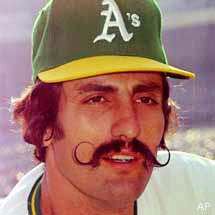 5. Rollie Fingers. The first closer in baseball was also the owner of the best moustache in sports history. Grab a hold of them handlebars, baby!
Trivia: who was the last MVP of each major pro league (NFL, MLB, NBA) with a moustache? (Answers in white). NFL: Randall Cunningham, Minnesota Vikings, 1998. MLB: Jeff Kent, San Francisco Giants, 1990. NBA: Karl Malone, Utah Jazz, 1999.
 4. William Howard Taft. Eveybody talks about Teddy Roosevelt, but Taft was our last president with facial hair. His moustache also kicks the hell out of T.R.'s comparatively feeble whiskers. Who doesn't love a fat man with a bushy mustache? It's possible that William Howard Taft came closer to looking like an actual walrus than any human being in human history.
 Trivia: who was the last major-party presidential candidate to wear a moustache? (Answer in white) Thomas Dewey, 1948.


3. (Tie) Burt Reynolds and Tom Selleck. The Bandit vs. Magnum, P.I. Smoldering machismo vs. smoldering machismo. The '70s stache vs. the '80s stache. Burt's whiskers have a blog; Tom's have a rock band. How do you choose? You don't. You sleep with both of them.
Incidentally, both Burt and Tom won serious cred by holding onto their whiskers well past the period of fashionability. Tom wore his well into the '90s--including his memorable guest-stint on "Friends"--and Burt was still sporting one as of the latest "Dukes of Hazzard" movie. These aren't fly-by-night facial-hair phonies, people. These are Men of the Moustache.
Trivia: Who was the last man to collect the Academy Award for Best Actor while wearing a moustache? (Answer in white). F. Murray Abraham, "Amadeus," 1984. Paul Newman may or may not have been wearing a moustache in 1986, when he won for "The Color of Money," but he didn't show up to the ceremony.
 1. Otto von Bismarck. I guess you could go with Chaplin or Dali or Zappa here, but while those guys were probably all assholes, the #1 moustache should go to an asshole who made war. Moustaches are apparently much more belligerent than watching a lot of gay porn might lead you to believe: Hitler, Stalin, Genghis Kahn, Bismark, Saddam Hussein, and the list goes on. I have a feeling I'm going to start acting like a total cock on New Years' Eve for no apparent reason.
Thursday, December 13, 2007
Top Five Music Videos for 1980s movie theme songs
The movie theme song music video is a delicate art, and the 80s were a pioneering time in their development. There are many
5. Huey Lewis and the News, "The Power of Love," from Back to the Future. The video has a two minute intro featuring Doc Brown arriving at a Huey Lewis show in the Delorean. Enough said.
4. Bill Medley and Jennifer Warnes, "Time of My Life," from Dirty Dancing. What is awesome about this video is that I can watch it and never feel the need to ever see Dirty Dancing, ever.
3. Kenny Loggins, "(Highway to the) Danger Zone", from Top Gun. Kenny Loggins + Fighter Jets = Awesome. Also: Iceman and Goose.
2. Survivor, "Eye of the Tiger", from Rocky III. Sadly, I can't find the actual Survivor video on Youtube, but it is on google video (possibly from China). It features the members of Survivor walking in time down the street while singing the song, and is reasonably awesome. Even more awesome, however, is the opening montage from Rocky III, depicted below, in which Rocky, now the champion, goes soft doing American Express ads and appearing on the Muppet Show while Clubber Lang (Mr. T) does some serious ass-kicking. You see, it is Clubber Lang, and not Rocky, who has the eye of the tiger by the end of the montage.
1. John Parr, "St. Elmo's Fire (Man in Motion)" from St. Elmo's Fire. The movie itself is a self-indulgent, taking-itself-way-too-seriously Joel Schumacher-directed tale of post-college life of a group of friends in 1980s Georgetown, which gave rise to the term "Brat Pack" for its cast (Rob Lowe, Demi Moore, Judd Nelson, Ally Sheedy, Andrew McCarthy, Emilio Estevez, Mare Winningham). The song is a fairly standard 80s anthem, apparently originally written as the theme song for some guy in a wheel-chair who was at the time going around the world to spread awareness for spinal cord injuries. The video is particularly awesome, featuring the perfect blend of scenes from the movie and shots of the ridiculous John Parr. Be sure to watch to the end, which features John Parr chilling out with the characters.
5. Huey Lewis and the News, "The Power of Love," from Back to the Future. The video has a two minute intro featuring Doc Brown arriving at a Huey Lewis show in the Delorean. Enough said.
4. Bill Medley and Jennifer Warnes, "Time of My Life," from Dirty Dancing. What is awesome about this video is that I can watch it and never feel the need to ever see Dirty Dancing, ever.
3. Kenny Loggins, "(Highway to the) Danger Zone", from Top Gun. Kenny Loggins + Fighter Jets = Awesome. Also: Iceman and Goose.
2. Survivor, "Eye of the Tiger", from Rocky III. Sadly, I can't find the actual Survivor video on Youtube, but it is on google video (possibly from China). It features the members of Survivor walking in time down the street while singing the song, and is reasonably awesome. Even more awesome, however, is the opening montage from Rocky III, depicted below, in which Rocky, now the champion, goes soft doing American Express ads and appearing on the Muppet Show while Clubber Lang (Mr. T) does some serious ass-kicking. You see, it is Clubber Lang, and not Rocky, who has the eye of the tiger by the end of the montage.
1. John Parr, "St. Elmo's Fire (Man in Motion)" from St. Elmo's Fire. The movie itself is a self-indulgent, taking-itself-way-too-seriously Joel Schumacher-directed tale of post-college life of a group of friends in 1980s Georgetown, which gave rise to the term "Brat Pack" for its cast (Rob Lowe, Demi Moore, Judd Nelson, Ally Sheedy, Andrew McCarthy, Emilio Estevez, Mare Winningham). The song is a fairly standard 80s anthem, apparently originally written as the theme song for some guy in a wheel-chair who was at the time going around the world to spread awareness for spinal cord injuries. The video is particularly awesome, featuring the perfect blend of scenes from the movie and shots of the ridiculous John Parr. Be sure to watch to the end, which features John Parr chilling out with the characters.
Monday, December 10, 2007
10 Great Novel Endings
Didn't some great critic or sage once say that the worst part of every great novel was its ending? That it's impossible, and artificial, to depart so abruptly from a rich world that has just been created? Or something like that. Maybe so, but here are 10 of my favorite such departures--and perhaps the best rebuttal to the 'anti-ending' argument I could come up with...
(Note: I'm using a liberal definition of "ending"--I don't just mean the final page or chapter necessarily, but the way the author takes leave of the larger universe of the novel. Although a smashing final page or line doesn't hurt, either.)
10. John O'Hara, Appointment In Samarra. O'Hara's hero, Julian English, completes his self-destruction in the final chapter. After mixing a highball drink in an enormous flower vase, he lurches into the garage and poisons himself with CO2 -- while semi-consciously regretting his actions the entire time. Has to be one of the best and most sensitive suicide scenes in literature.
9. Frank Norris, McTeague. It's impossible to render the context for this one fairly, but suffice it to say it involves a man handcuffed to the corpse of his former best friend, dying of thirst in the middle of Death Valley. Hard to beat for pure brutality, anyway.
8. Thomas Hardy, Tess of the D'urbervilles. Hardy wrote a lot of great endings, and I was tempted to go for the near-triple drowning in Return of the Native... but nothing beats Stonehenge (yes, that counts as part of the ending sequence). I guess it's probably inevitable that a best-endings-of-all-time list would have considerable overlap with a favorite-books-of-all-time list.
7. Martin Amis, Time's Arrow. I read this thinking it was more or less an exercise in cheerful gimmickry. The ending (or the last quarter or so of the book) got me pretty good. Back, back, into the darkness.
6. Jane Austen, Persuasion. Gut-punch tragedies have a natural advantage over happy endings, but there should be at least one place on here for a brisk, beautifully executed triumph.
5. Kazuo Ishiguro, Remains of the Day. The suffocating melancholy here is a nice contrast against the special-effects melodrama of Samarra and McTeague. As I think we discussed in the "saddest books" list, sad doesn't have to be showy.
4. F. Scott Fitzgerald, The Great Gatsby. The most famous ending in American literature? (The "boats against the current" bit made it onto season 2 of The Wire). It deserves the hype.
3. Edith Wharton, The Age of Innocence. Quietly crushing, like the Ishiguro, but even a bit better.
2. Vladmir Nabokov, Lolita. Amid the hilarity and perversity and the virtuosity, people forget that this thing is a real heartbreaker at the end. Humbert's last visit with Dolly is gorgeously wrought, as is his final, misty-eyed ramble through the countryside.
1. William Faulkner, Absalom, Absalom. Beyond everything else, Faulkner practically squeezes the tragedy of the Sutpens, the Compsons, and American history into just a few lines:
"...Now I want you to tell me just one thing more. Why do you hate the South?"
" 'I don't hate it,' he said. I dont hate it he thought, panting the cold air, the iron New England dark: I dont. I dont! I dont hate it! I dont hate it!"
(Note: I'm using a liberal definition of "ending"--I don't just mean the final page or chapter necessarily, but the way the author takes leave of the larger universe of the novel. Although a smashing final page or line doesn't hurt, either.)
10. John O'Hara, Appointment In Samarra. O'Hara's hero, Julian English, completes his self-destruction in the final chapter. After mixing a highball drink in an enormous flower vase, he lurches into the garage and poisons himself with CO2 -- while semi-consciously regretting his actions the entire time. Has to be one of the best and most sensitive suicide scenes in literature.
9. Frank Norris, McTeague. It's impossible to render the context for this one fairly, but suffice it to say it involves a man handcuffed to the corpse of his former best friend, dying of thirst in the middle of Death Valley. Hard to beat for pure brutality, anyway.
8. Thomas Hardy, Tess of the D'urbervilles. Hardy wrote a lot of great endings, and I was tempted to go for the near-triple drowning in Return of the Native... but nothing beats Stonehenge (yes, that counts as part of the ending sequence). I guess it's probably inevitable that a best-endings-of-all-time list would have considerable overlap with a favorite-books-of-all-time list.
7. Martin Amis, Time's Arrow. I read this thinking it was more or less an exercise in cheerful gimmickry. The ending (or the last quarter or so of the book) got me pretty good. Back, back, into the darkness.
6. Jane Austen, Persuasion. Gut-punch tragedies have a natural advantage over happy endings, but there should be at least one place on here for a brisk, beautifully executed triumph.
5. Kazuo Ishiguro, Remains of the Day. The suffocating melancholy here is a nice contrast against the special-effects melodrama of Samarra and McTeague. As I think we discussed in the "saddest books" list, sad doesn't have to be showy.
4. F. Scott Fitzgerald, The Great Gatsby. The most famous ending in American literature? (The "boats against the current" bit made it onto season 2 of The Wire). It deserves the hype.
3. Edith Wharton, The Age of Innocence. Quietly crushing, like the Ishiguro, but even a bit better.
2. Vladmir Nabokov, Lolita. Amid the hilarity and perversity and the virtuosity, people forget that this thing is a real heartbreaker at the end. Humbert's last visit with Dolly is gorgeously wrought, as is his final, misty-eyed ramble through the countryside.
1. William Faulkner, Absalom, Absalom. Beyond everything else, Faulkner practically squeezes the tragedy of the Sutpens, the Compsons, and American history into just a few lines:
"...Now I want you to tell me just one thing more. Why do you hate the South?"
" 'I don't hate it,' he said. I dont hate it he thought, panting the cold air, the iron New England dark: I dont. I dont! I dont hate it! I dont hate it!"
Thursday, November 8, 2007
Historical Novels - Another Addendum
I love Matt and Akshay's lists and felt compelled to add one of my own. If The Confessions of Nat Turner and The Hunchback of Notre Dame hadn't been mentioned I would definitely have included them on mine.
6. Charles Dickens, A Tale of Two Cities – I forget if this is Dickens’ only or one of his two historical novels. It’s wonderfully inaccurate (was it Orwell who complained that Dickens was responsible for making everyone associate carriages with death?), more a pastiche with the French terror as a backdrop, and terribly entertaining. I read it again a few years ago after slogging through it in high school and managed to tear through it in a day. Damn you, Madame Defarge!
5. Isaac Bashevis Singer, The Manor and The Estate – It’s the history of a rich Jewish family in Poland from 1862 until the end of the 19th century, plotted like an 800 page train wreck, with one disaster befalling the tragically imperfect Calman Jacoby and his daughters after the other. From Singer’s introduction: “All the spiritual and intellectual ideas that triumphed in the modern era had their roots in the world of that time – socialism and nationalism, Zionism and assimilationism, nihilism and anarchism, suffragettism, atheism, the weakening of the family bond, free love, and even the beginnings of Fascism.” There’s also a paragraph in the text dedicated to vegetarianism. I don’t think a similar novel of our own time concentrating on “post-modernism and Christian fundamentalism, anti-Islamo-fascism and Obama-fascination,” would carry as great a weight.
4. Philip Roth, American Pastoral – The best American novel of the last 30 or so years may not count as historical, as Roth lived through all the events he describes. But there’s a strangeness with which he recreates the optimism of post-war Newark in the 40s and 50s and then the horrors of the 60s. John complained in a comment on a previous list that he disliked soundtracks that lazily presented the 60s as a wild and crazy time. American Pastoral is the only work of art that has convinced me that it was.
3, Primo Levi, If Not Now, When? – Levi did a great deal of research to imagine an alternative life during World War II, not as a Holocaust detainee, but as a partisan fighter whose suffering seemed to have more meaning and purpose. The Jew who expresses his sympathy for Dresden’s victims felt like a liberal transplant from 1982, when the novel was written, but I was willing to forgive the transgression.
2. Alexander Solzhenitsyn, Cancer Ward – Solzhenitsyn wrote a true historical magnum opus about World War I which I haven’t read, but Cancer Ward brings back a very specific moment during the Khruschev Thaw, when Stalin’s victims were just coming to terms with the hell of their camps, and everyone was looking forward, very uncertainly to a less-than-promising future. I’ve met quite a few Eastern Europeans who have told me that this book actually speaks to their feelings right after 1989.
1. Ivo Andric, The Days of the Consuls, a.k.a. Bosnian Story, a.k.a. Bosnian Chronicle – Andric’s claustrophobic book is about a group of second-rate diplomats stationed in Travnik, Bosnia during the Napoleonic Wars. It touches anyone whose ever been an expatriate stationed in a small country, and who comes from an empire about to be neutered.
6. Charles Dickens, A Tale of Two Cities – I forget if this is Dickens’ only or one of his two historical novels. It’s wonderfully inaccurate (was it Orwell who complained that Dickens was responsible for making everyone associate carriages with death?), more a pastiche with the French terror as a backdrop, and terribly entertaining. I read it again a few years ago after slogging through it in high school and managed to tear through it in a day. Damn you, Madame Defarge!
5. Isaac Bashevis Singer, The Manor and The Estate – It’s the history of a rich Jewish family in Poland from 1862 until the end of the 19th century, plotted like an 800 page train wreck, with one disaster befalling the tragically imperfect Calman Jacoby and his daughters after the other. From Singer’s introduction: “All the spiritual and intellectual ideas that triumphed in the modern era had their roots in the world of that time – socialism and nationalism, Zionism and assimilationism, nihilism and anarchism, suffragettism, atheism, the weakening of the family bond, free love, and even the beginnings of Fascism.” There’s also a paragraph in the text dedicated to vegetarianism. I don’t think a similar novel of our own time concentrating on “post-modernism and Christian fundamentalism, anti-Islamo-fascism and Obama-fascination,” would carry as great a weight.
4. Philip Roth, American Pastoral – The best American novel of the last 30 or so years may not count as historical, as Roth lived through all the events he describes. But there’s a strangeness with which he recreates the optimism of post-war Newark in the 40s and 50s and then the horrors of the 60s. John complained in a comment on a previous list that he disliked soundtracks that lazily presented the 60s as a wild and crazy time. American Pastoral is the only work of art that has convinced me that it was.
3, Primo Levi, If Not Now, When? – Levi did a great deal of research to imagine an alternative life during World War II, not as a Holocaust detainee, but as a partisan fighter whose suffering seemed to have more meaning and purpose. The Jew who expresses his sympathy for Dresden’s victims felt like a liberal transplant from 1982, when the novel was written, but I was willing to forgive the transgression.
2. Alexander Solzhenitsyn, Cancer Ward – Solzhenitsyn wrote a true historical magnum opus about World War I which I haven’t read, but Cancer Ward brings back a very specific moment during the Khruschev Thaw, when Stalin’s victims were just coming to terms with the hell of their camps, and everyone was looking forward, very uncertainly to a less-than-promising future. I’ve met quite a few Eastern Europeans who have told me that this book actually speaks to their feelings right after 1989.
1. Ivo Andric, The Days of the Consuls, a.k.a. Bosnian Story, a.k.a. Bosnian Chronicle – Andric’s claustrophobic book is about a group of second-rate diplomats stationed in Travnik, Bosnia during the Napoleonic Wars. It touches anyone whose ever been an expatriate stationed in a small country, and who comes from an empire about to be neutered.
Wednesday, November 7, 2007
Historical Novels: An Addendum
Akshay's list is terrific -- a great topic, and fascinating-sounding selections (I say that because, not in spite of, having read only one of his ten honorees). Is it thunder-stealing, or thunder-appreciating, to offer a mini list of my own? I hope the latter.
5. William Gilmore Simms, The Scout. If you don't count Poe -- and there are good reasons for not counting Poe -- Simms is the dean of antebellum Southern novelists. I know, I know, that's like being the dean of Burmese gangsta rappers. But I enjoyed this Revolutionary War novel significantly more than anything historical by Fenimore Cooper, Simms's Northern model in the genre.
4. Victor Hugo, The Hunchback of Notre Dame. This is my version of The Shogun -- I read it at 14, loved it, and don't care to know if it's actually just gassy romanticism.
3. William Styron, Confessions of Nat Turner. Styron's version of the Turner rebellion was historically and politically controversial (OK with Eugene Genovese, not OK with certain black activists), but it works for me. Having read some of the academic history about Turner, I'd have to say this is another example (like Vidal's Lincoln) where brilliant, thoughtful fiction totally outshines workmanlike historical scholarship.
2. John Updike, Memoirs of the Ford Administration. Really a book-in-a-book -- Updike's narrator is an oversexed history prof in the '70s, writing a fictional life of James Buchanan. Both books are good, and Updike's quasi-defense of possibly The Worst President In History is surprisingly compelling.
1. Robert Graves, I Claudius. Along with its sequel, Claudius The God, this is endless fun. A sharp, distinctive, enduring take on all the personalities of the early Empire (partly lifted from Suetonius, but that's OK). Better than HBO's Rome, and I liked Rome. Has anyone read anything else by Graves? He has a 400 page novel on Belisarius which sounds pretty great.
Honorable Mentions:
* William Faulkner, Absalom, Absalom. Is this a historical novel? Sure, John C. Calhoun and Robert E. Lee don't make appearences, but this book IS the antebellum South. That should count for something. And if it does count, it has to be #1.
* William Thackeray, Henry Esmond . Surely THE WORST historical novel I've ever read. I loved, loved, loved Vanity Fair, but this -- supposed to be Thackeray's #2 or #3 -- is dry, stilted, and repetitive. Wikipedia says it's about the Jacobite rebellion, but I swear I've forgotten everything about this book. A shame, because the sequel, The Virginians, sounds promising on paper. But after that nightmare, I'm not gonna bite.
5. William Gilmore Simms, The Scout. If you don't count Poe -- and there are good reasons for not counting Poe -- Simms is the dean of antebellum Southern novelists. I know, I know, that's like being the dean of Burmese gangsta rappers. But I enjoyed this Revolutionary War novel significantly more than anything historical by Fenimore Cooper, Simms's Northern model in the genre.
4. Victor Hugo, The Hunchback of Notre Dame. This is my version of The Shogun -- I read it at 14, loved it, and don't care to know if it's actually just gassy romanticism.
3. William Styron, Confessions of Nat Turner. Styron's version of the Turner rebellion was historically and politically controversial (OK with Eugene Genovese, not OK with certain black activists), but it works for me. Having read some of the academic history about Turner, I'd have to say this is another example (like Vidal's Lincoln) where brilliant, thoughtful fiction totally outshines workmanlike historical scholarship.
2. John Updike, Memoirs of the Ford Administration. Really a book-in-a-book -- Updike's narrator is an oversexed history prof in the '70s, writing a fictional life of James Buchanan. Both books are good, and Updike's quasi-defense of possibly The Worst President In History is surprisingly compelling.
1. Robert Graves, I Claudius. Along with its sequel, Claudius The God, this is endless fun. A sharp, distinctive, enduring take on all the personalities of the early Empire (partly lifted from Suetonius, but that's OK). Better than HBO's Rome, and I liked Rome. Has anyone read anything else by Graves? He has a 400 page novel on Belisarius which sounds pretty great.
Honorable Mentions:
* William Faulkner, Absalom, Absalom. Is this a historical novel? Sure, John C. Calhoun and Robert E. Lee don't make appearences, but this book IS the antebellum South. That should count for something. And if it does count, it has to be #1.
* William Thackeray, Henry Esmond . Surely THE WORST historical novel I've ever read. I loved, loved, loved Vanity Fair, but this -- supposed to be Thackeray's #2 or #3 -- is dry, stilted, and repetitive. Wikipedia says it's about the Jacobite rebellion, but I swear I've forgotten everything about this book. A shame, because the sequel, The Virginians, sounds promising on paper. But after that nightmare, I'm not gonna bite.
Tuesday, November 6, 2007
Best Historical Novels
Note: there are huge gaps in my knowledge. I haven't read any Graves or Scott or Manzoni, so this is rather incomplete. Also, I'm not sure I have a particularly coherent idea of what actually makes something a historical novel.
1. Stendhal, The Charterhouse of Parma
(Man, this book was fun to read! I'm not totally sure that it counts as a historical novel, since the events took place during Stendhal's lifetime and he actually did fight with Napoleon. But it has a historical novel air that is somehow missing from, for example, War and Peace. I think Stendhal based a lot of the court intrigue off much older Italian memoirs.)
2. Marguerite Yourcenar, The Memoirs of Hadrian
(A really wonderful book, and it weaves its spell not through physical period detail - of which there is surprisingly little - but by recreating habits of thought.)
3. Penelope Fitzgerald, The Blue Flower
(A life of the poet Novalis and Fitzgerald's last, great book. One of the saddest last pages in modern literature. Her final three or four books were all wonderful historical novels.)
4. Anthony Burgess, Nothing Like the Sun
(I have a weakness for lives of artists. This one is about Shakespeare, written in a beautiful mix of modern and Elizabethan English.)
5. Virginia Woolf, Orlando
(Proceeds gleefully through three hundreds years of history with Queen Elizabeth and Alexander Pope as main figures, along with a shifting stable of characters who appear to be virtually immortal and keep changing gender. One of the most delightful and baffling and infuriating books I've ever read.)
6. John Fowles, The French Lieutenant's Woman
(I've never quite looked at a Victorian novel the same way after finishing this book, even though some of its narrative tricks annoyed me a great deal.)
6. Gore Vidal, Lincoln
(I haven't read much other Vidal outside the essays, but I did enjoy this book a lot. I'm not sure it's of the same caliber as the other books on the list, but we need some Americans on this list.)
7. J. G. Farrell, The Siege of Krishnapur
(A wonderful read - immensely funny and exciting and also an interesting meditation on the nature of progress. I was a little offended by how the Sepoys were portrayed, but I got over my outraged national feeling - Farrell's representation makes a lot more sense than a noble Hollywood Sepoy walk-on would have.)
8. Italo Calvino, The Baron in the Trees
(A delight! Probably the most purely pleasurable book on the list.)
9. Patrick White, Voss
(A rather disturbing tale about the exploration of the Australian outback in, I think, the early 19th century. I read it a long time ago and have forgotten most of it except for the rather horrifying conclusion.)
10. James Clavell, Shogun
(When I was twelve, I was pretty sure this was the greatest book ever written. I'm scared to look at it again because I have no real desire to find out that it's just cheesy epic romance. Anyway, even if it is, it is damn good cheesy epic romance.)
1. Stendhal, The Charterhouse of Parma
(Man, this book was fun to read! I'm not totally sure that it counts as a historical novel, since the events took place during Stendhal's lifetime and he actually did fight with Napoleon. But it has a historical novel air that is somehow missing from, for example, War and Peace. I think Stendhal based a lot of the court intrigue off much older Italian memoirs.)
2. Marguerite Yourcenar, The Memoirs of Hadrian
(A really wonderful book, and it weaves its spell not through physical period detail - of which there is surprisingly little - but by recreating habits of thought.)
3. Penelope Fitzgerald, The Blue Flower
(A life of the poet Novalis and Fitzgerald's last, great book. One of the saddest last pages in modern literature. Her final three or four books were all wonderful historical novels.)
4. Anthony Burgess, Nothing Like the Sun
(I have a weakness for lives of artists. This one is about Shakespeare, written in a beautiful mix of modern and Elizabethan English.)
5. Virginia Woolf, Orlando
(Proceeds gleefully through three hundreds years of history with Queen Elizabeth and Alexander Pope as main figures, along with a shifting stable of characters who appear to be virtually immortal and keep changing gender. One of the most delightful and baffling and infuriating books I've ever read.)
6. John Fowles, The French Lieutenant's Woman
(I've never quite looked at a Victorian novel the same way after finishing this book, even though some of its narrative tricks annoyed me a great deal.)
6. Gore Vidal, Lincoln
(I haven't read much other Vidal outside the essays, but I did enjoy this book a lot. I'm not sure it's of the same caliber as the other books on the list, but we need some Americans on this list.)
7. J. G. Farrell, The Siege of Krishnapur
(A wonderful read - immensely funny and exciting and also an interesting meditation on the nature of progress. I was a little offended by how the Sepoys were portrayed, but I got over my outraged national feeling - Farrell's representation makes a lot more sense than a noble Hollywood Sepoy walk-on would have.)
8. Italo Calvino, The Baron in the Trees
(A delight! Probably the most purely pleasurable book on the list.)
9. Patrick White, Voss
(A rather disturbing tale about the exploration of the Australian outback in, I think, the early 19th century. I read it a long time ago and have forgotten most of it except for the rather horrifying conclusion.)
10. James Clavell, Shogun
(When I was twelve, I was pretty sure this was the greatest book ever written. I'm scared to look at it again because I have no real desire to find out that it's just cheesy epic romance. Anyway, even if it is, it is damn good cheesy epic romance.)
Subscribe to:
Posts (Atom)